Connecticut's new AI law, explained: what SB 5 means for businesses and how Easie was involved
Connecticut Senate Bill 5 (SB 5), signed into law as Public Act No. 26-15 on May 27, 2026, is one of the most comprehensive state AI laws in the United States. It regulates AI in hiring decisions, sets safety standards for AI companion chatbots, protects whistleblowers at frontier AI labs, requires provenance data on AI-generated media, and funds AI workforce training through a new Connecticut AI Academy at Charter Oak State College.
Easie advocated for this legislation across the 2024, 2025, and 2026 Connecticut legislative sessions. This guide explains what the law does, who it affects, and how to get fast answers about any provision.
What is Connecticut SB 5 (Public Act 26-15)?
Connecticut SB 5, "An Act Concerning Online Safety," is a state law signed by Governor Ned Lamont on May 27, 2026, that regulates high-risk uses of artificial intelligence while investing in AI workforce development. It was introduced by the General Law Committee and championed by Senator James Maroney, who has led Connecticut's AI policy work for years. The five biggest things it does:
AI in employment decisions: Starting with deployments on or after October 1, 2027, employers must disclose when automated employment decision technology (AEDT) is a substantial factor in hiring, promotion, discipline, or firing, and provide written notice of what data the tool analyzes. Using an algorithm is no longer a defense to a discrimination claim, and courts and the CHRO may consider evidence of anti-bias testing, including its results and the employer's response.
AI companion safety: Effective January 1, 2027, AI companion operators must detect expressions of suicide or self-harm risk and refer users to the 988 Lifeline, must never claim to be human, and must block romantic or sexually explicit interactions and manipulative engagement tactics with minors.
Frontier AI whistleblower protections: Effective October 1, 2026, developers training models above 10^26 operations of compute cannot adopt policies or contracts that penalize employees for reporting catastrophic risks, and large developers must run anonymous internal reporting channels by January 1, 2027.
AI content provenance: Effective October 1, 2026, generative AI providers with over one million monthly users must, where commercially and technically reasonable, embed tamper-resistant provenance data (such as the C2PA standard) in AI-generated images, audio, and video.
Workforce investment: A Connecticut AI Academy at Charter Oak State College (established by December 31, 2026) offering AI courses for residents, small businesses, nonprofits, and teachers, plus a planned AI regulatory sandbox.
You can read the full official text in the Public Act 26-15 PDF on cga.ct.gov.
Does SB 5 stifle AI innovation in Connecticut?
No. SB 5 does not license AI models, require government pre-approval to ship products, or regulate everyday business use of AI for drafting, coding, analysis, or customer service.
A Connecticut company using AI to process invoices or answer support tickets has essentially no new obligations under this law, and gains training resources, published state datasets, talent pipelines, and a coming regulatory sandbox.
The obligations attach only to the highest-stakes applications: algorithms deciding who gets hired and fired, products forming emotional relationships with children, models capable of catastrophic harm, and synthetic media at mass scale. Good guardrails can be pro-innovation, and SB 5 is the proof.
How was Easie involved in passing SB 5?
Easie advocated for Connecticut AI legislation across three consecutive legislative sessions, working alongside Senator James Maroney, his cosponsors, and the Connecticut AI working group:
2024: Easie founder and CEO Rock Vitale joined a roundtable of the AI task force at the Yale AI Summit.
2025: Vitale testified before the General Law Committee in support of SB 2, the predecessor bill, and that May joined 17 other Connecticut small businesses in the innovation economy in a coalition letter urging House leadership to call SB 2 for a vote.
2026: Vitale testified in support of SB 5 on March 4, 2026, offering suggestions drawn from Easie's hands-on experience implementing AI for businesses of every size. The bill passed the Senate on April 21, the House on May 1, and was signed May 27.
Easie's advocacy extends to the federal level as well. On August 5, 2025, Vitale spoke at the Connecticut State Capitol in Hartford alongside Senator Richard Blumenthal, giving remarks on the AI Accountability and Personal Data Protection Act, the bipartisan bill Senators Hawley and Blumenthal introduced on July 21, 2025.
The bill would let individuals sue anyone who appropriates, uses, or exploits their personal data or copyrighted works without clear, affirmative consent, with AI training as its central target.
The final law reflects real legislative iteration: industry concerns about SB 2's breadth were answered by narrowing the automated decision provisions to employment, sharpening the AI companion definitions so ordinary business chatbots are exempt, and pairing every mandate with workforce investment. The complete legislative record is on the official SB 5 bill page.
What is Easie?
Easie is an implementation-focused AI and automation firm founded in 2018 and serving clients across more than 40 industries. Easie builds and deploys production AI systems, computer vision, document extraction, natural language processing, and workflow automation, for startups, middle-market companies, enterprises, nonprofits, and universities through its modular EasieOps platform.
Easie was doing document AI and computer vision years before large language models made AI a boardroom topic, and its policy positions come from shipping these systems in the real world, not from theory.
The consistent lesson from that work is that clear rules for the highest-risk uses are the infrastructure that lets everyone else adopt with confidence.
Ask the SB 5 chatbot anything about the law
In the spirit of celebrating the launch of this law, we built an AI chatbot, powered by an EasieOps AI agent, that answers detailed natural language questions about SB 5. Ask it what the hiring provisions require, when the AI companion rules take effect, or what the law means for your business, and it answers with section citations and links to official sources.
Try the SB 5 chatbot here and see what an EasieOps AI agent can do with your own documents and data.
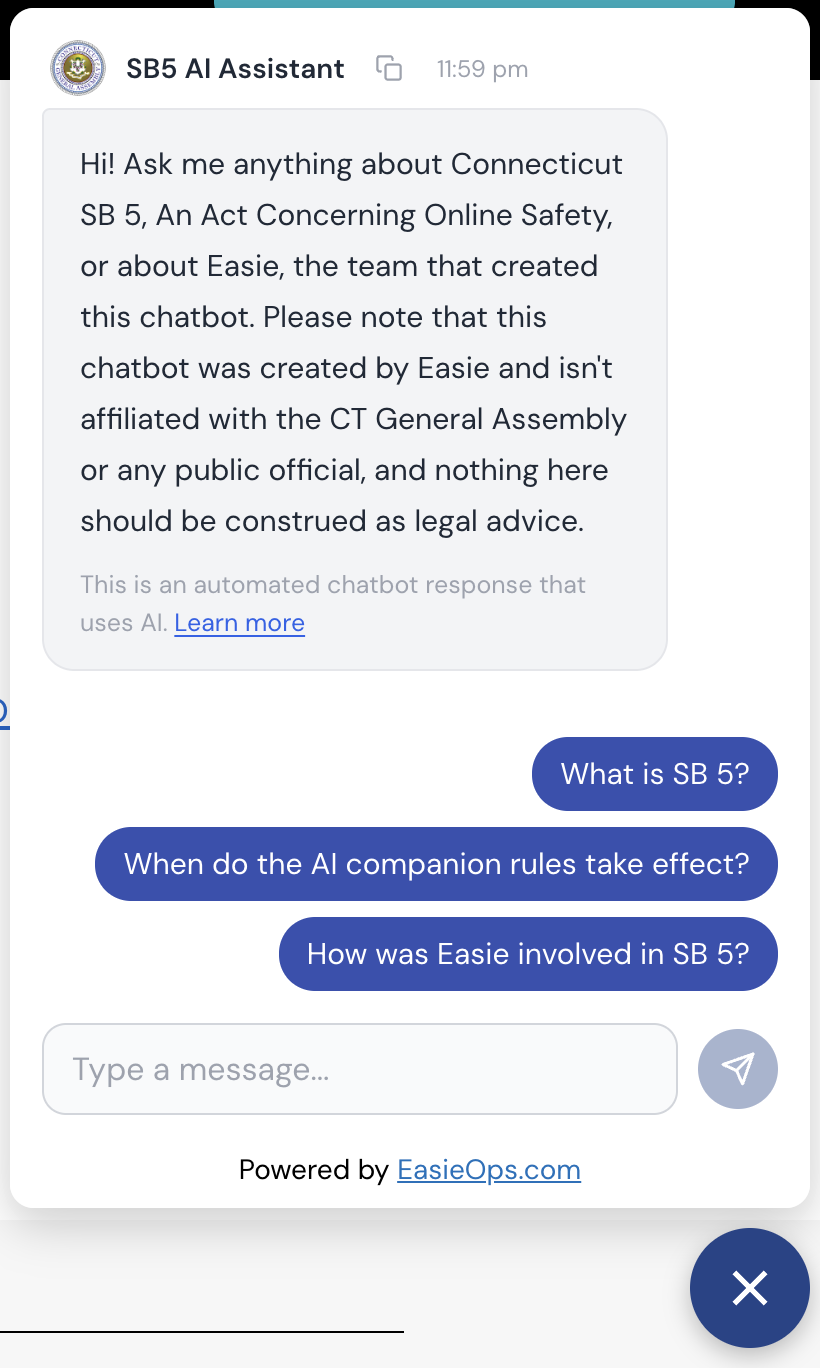
Figure 1 - SB5 AI chatbot built on EasieOps
Please note that this chatbot was created by Easie and isn't affiliated with the CT General Assembly or any public official, and nothing here should be construed as legal advice. For hands-on help building or adapting AI systems, book a consultation with Easie.
Frequently asked questions about Connecticut SB 5
When was Connecticut SB 5 signed into law? Governor Ned Lamont signed SB 5 as Public Act No. 26-15 on May 27, 2026, after the Senate passed it on April 21, 2026 and the House on May 1, 2026.
When does SB 5 take effect? In phases: subscription transparency, whistleblower protections, provenance, and the AEDT framework on October 1, 2026; AI companion requirements on January 1, 2027; AEDT disclosure duties for deployments on or after October 1, 2027; and social media protections for minors on January 1, 2028.
Who enforces SB 5? The Connecticut Attorney General enforces most regulatory provisions as unfair trade practices under CUTPA, and most sections expressly exclude private lawsuits. The frontier developer provisions instead carry Attorney General civil penalties, and AEDT violations through December 31, 2027 may receive a 60-day cure period.
Does SB 5 apply to small businesses using AI? Generally no. Everyday business use of AI is untouched. Obligations apply mainly to employers using AI as a substantial factor in employment decisions (starting October 2027), AI companion operators, subscription AI providers, large generative AI providers, frontier model developers, and social media platforms.
What is the Connecticut AI Academy? An AI education program established by SB 5 at Charter Oak State College by December 31, 2026, offering online AI courses, digital literacy programs, teacher training, and practical AI training for small businesses and nonprofits, with certificates and badges.
Need help navigating SB 5 or deploying AI the right way?
Easie helps teams design and ship production AI systems, from document extraction and automation to custom AI agents, built to hold up under laws like Public Act 26-15.
If you are working through compliance questions or AI projects like the ones in this article and want hands-on guidance, please reach out.
This post is for general informational purposes only, and nothing in it should be construed as legal advice. For guidance on how Public Act 26-15 applies to your organization, consult an attorney.
